45 min
Sorrento to Pompeii Express: Skip-the-Line Guided Train Tour
- Priority access
- Skip the queue
- Mobile voucher
- Free cancellation
Pompeii Tours From Sorrento — Guided Entry & Ruins Access
Ash preserved a Roman city, and the road from Sorrento reaches it.
Compare fares, pick the fit — all bookings are mobile-voucher and eligible for free cancellation where shown.
45 min
4 hr
8 hr
Worth it for first-time visitors and history lovers
For most travellers, pompeii tours from sorrento earn their keep on pure value math. Standard adult entry is 20 EUR per person, and that single figure unlocks roughly 44 hectares of excavated Roman city — paved streets, frescoed villas, bakeries, bathhouses and the plaster casts that make the eruption feel immediate. Measured against the scale and the fact that no other site preserves daily Roman life so completely, twenty euros reads as fair rather than steep. A guided Pompeii archaeological tour or skip-the-line Pompeii admission adds cost but pays off in context you would otherwise miss among the ruins and UNESCO-listed Campania landmarks. Who gets the most from a pompeii tours from sorrento tour: first-timers, ancient-history buffs, and anyone who reads plaques. Who might balk: visitors chasing a quick photo stop, or those unprepared for a hot, largely shadeless walk across broad stone forums.
Bottom line: At 20 EUR for a Roman city frozen mid-life, a pompeii tours from sorrento tours booking is worth it for anyone who actually wants to understand what they're walking through.
For a Sorrento base, most travelers should still lead with pompeii tours from sorrento and treat Herculaneum as the smaller add-on, since Pompeii's scale suits a full skip-the-line Pompeii tour while Herculaneum rewards only those short on stamina or heat tolerance.
|
Top pick Pompeii |
Herculaneum | |
|---|---|---|
| Site size | 66 hectares (163 acres) excavated | |
| Preservation style | Ash-buried, structural ruins, some frescoes | Pyroclastic-sealed, wood and roofs intact |
| Crowd levels | High — 2.5 million+ visitors yearly | Lower — under 500,000 visitors yearly |
| Time needed | 4-8 hours for a full visit | 2-3 hours covers the site |
| Ticket price | 20 EUR standard adult entry | 13 EUR standard adult entry |
| Ease of day trip from Sorrento | Direct Circumvesuviana, ~40 min | Direct Circumvesuviana, ~50 min |
| Shade and heat exposure | Very little shade, open stone streets | Slightly more shade, compact layout |
| See tickets & prices |
Verdict: Choose Pompeii for scope and iconic landmarks on a Sorrento day trip, but pick Herculaneum if you want a shorter, cooler visit with denser, better-preserved detail.
Hand-picked experiences loved by thousands of travelers
8.5 – 9 hours
Free Cancellation
Conquer an active volcano, feast on Neapolitan pizza, then walk the streets of ancient Rome — all in one epic day.
4 – 6 hours
Free Cancellation
Step back 2,000 years exploring Pompeii's preserved streets, baths & forum — skip the queues.
2 hours (plus approx. 80 minutes total travel time by train)
Free Cancellation
Step back 2,000 years on a 2-hour expert-guided walk through ancient Pompeii, departing from Sorrento.
Enter through the ancient sea gate, the closest access point to the Pompei Scavi train station
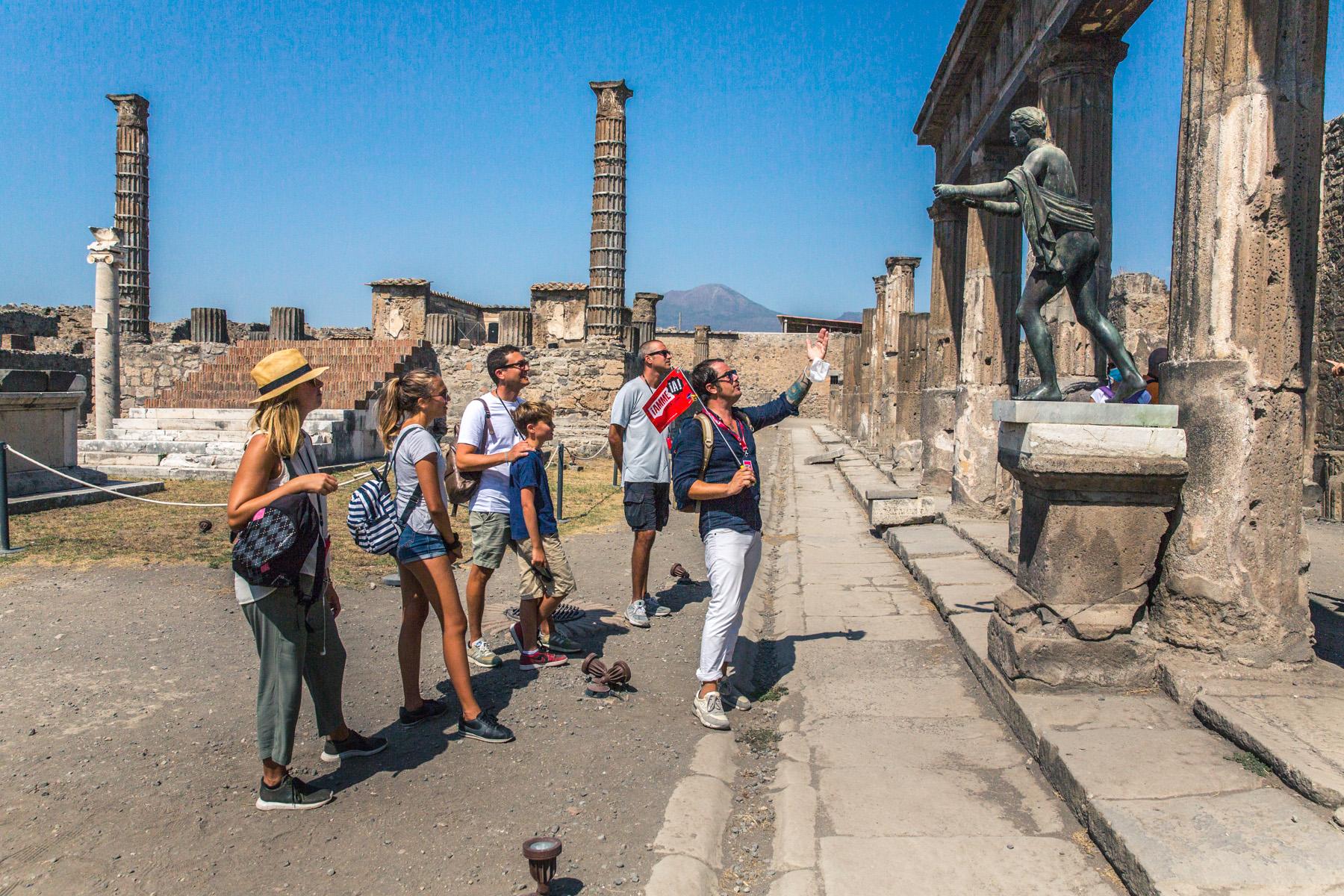
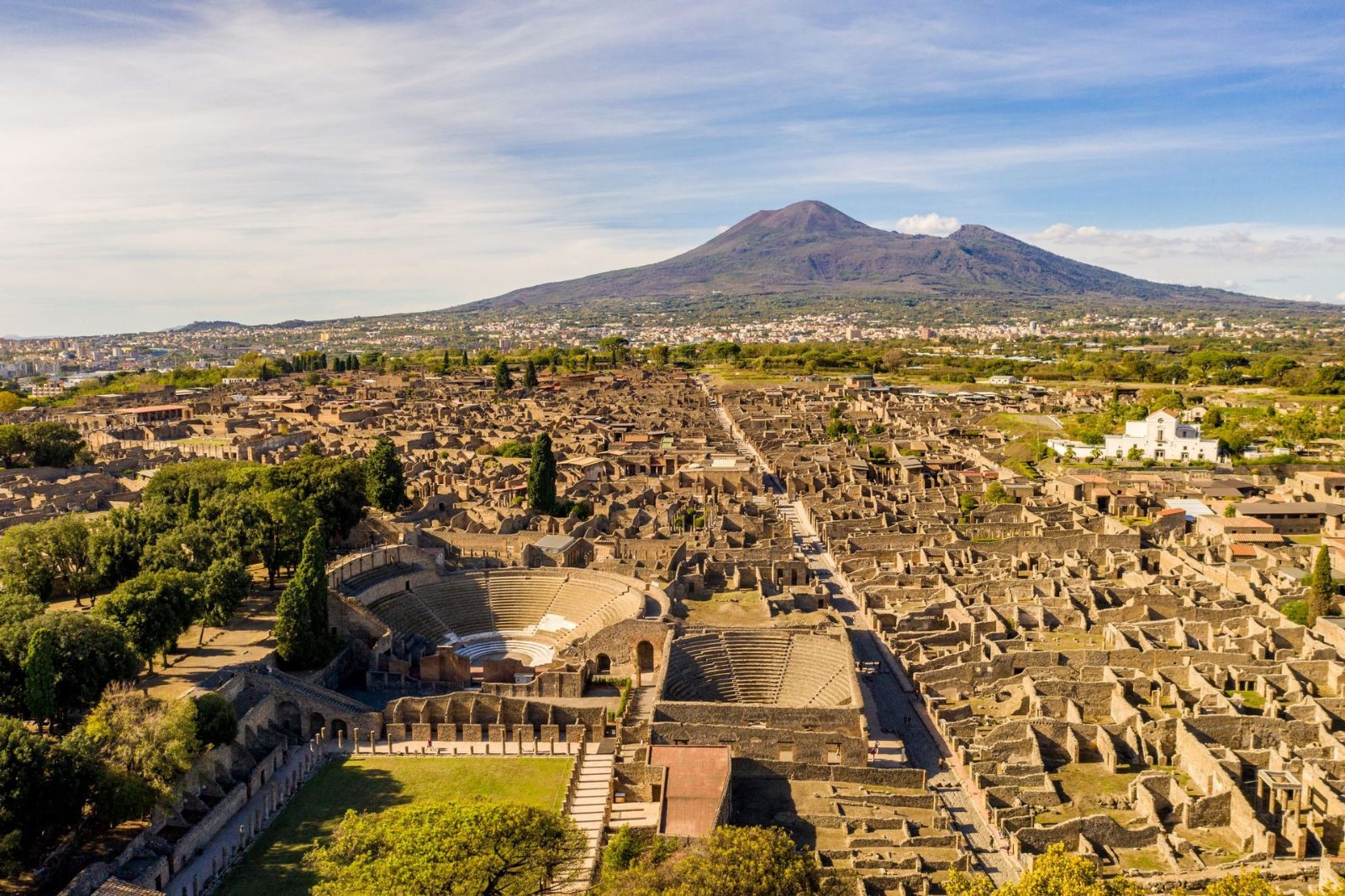
Explore the civic and religious heart of the ancient city, framed by Vesuvius in the background
View one of the largest domus in Pompeii, known for its mosaic floors
Walk through the best-preserved Roman bathing complex on the site
Finish at the oldest known Roman amphitheater, built around 70 BCE
Optional detour to see the frescoed dining room outside the main walls
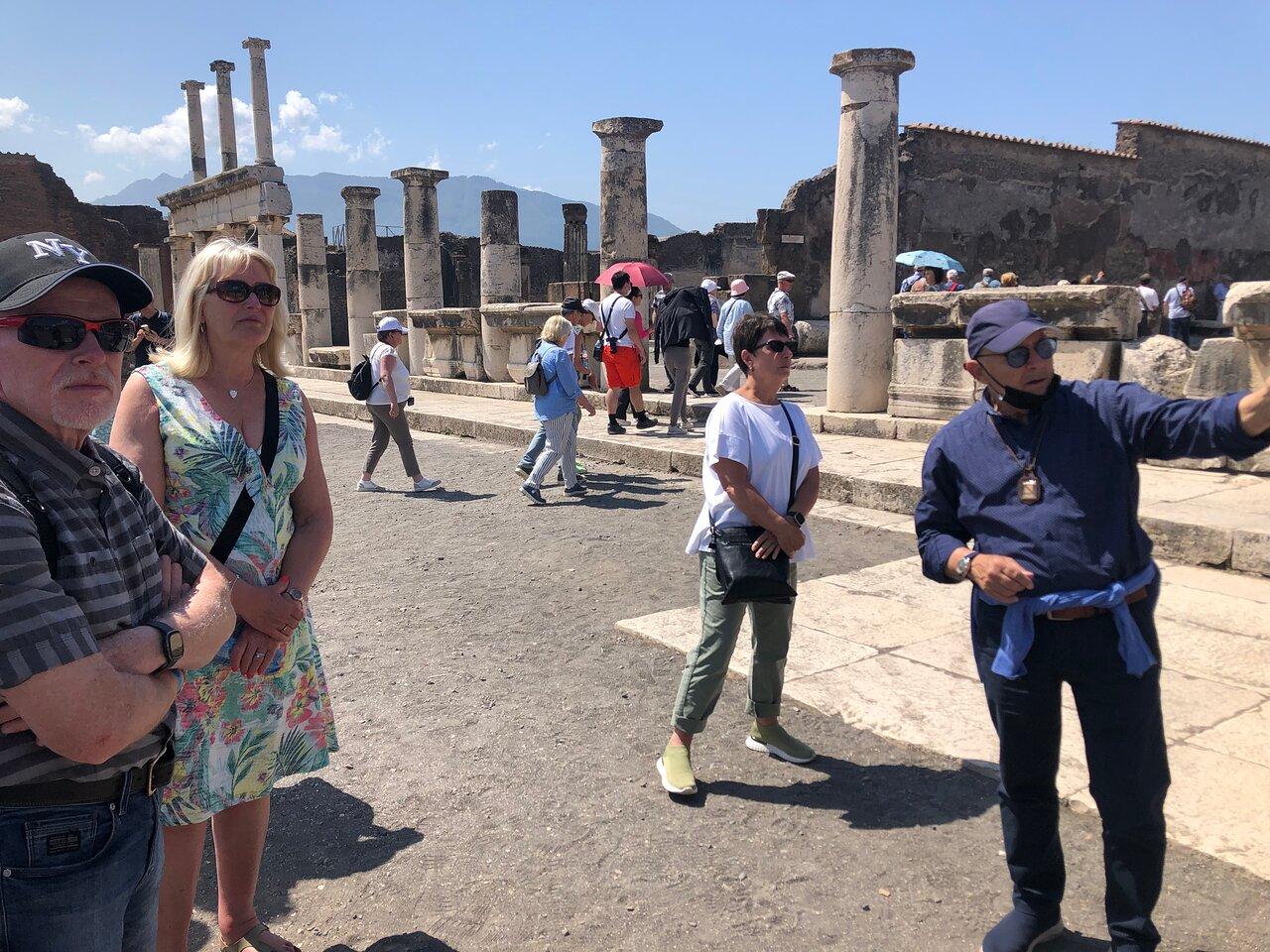
The civic, religious, and commercial center of ancient Pompeii, framed dramatically by Mount Vesuvius in the background. Surrounding colonnades once supported public buildings including the basilica and temples, and the open rectangular plaza measures roughly 142 by 38 meters.
One of the largest private residences in Pompeii, covering nearly 3,000 square meters, named for the bronze statuette of a dancing faun found at its entrance. It also once housed the famous Alexander Mosaic, now preserved in the Naples Archaeological Museum.
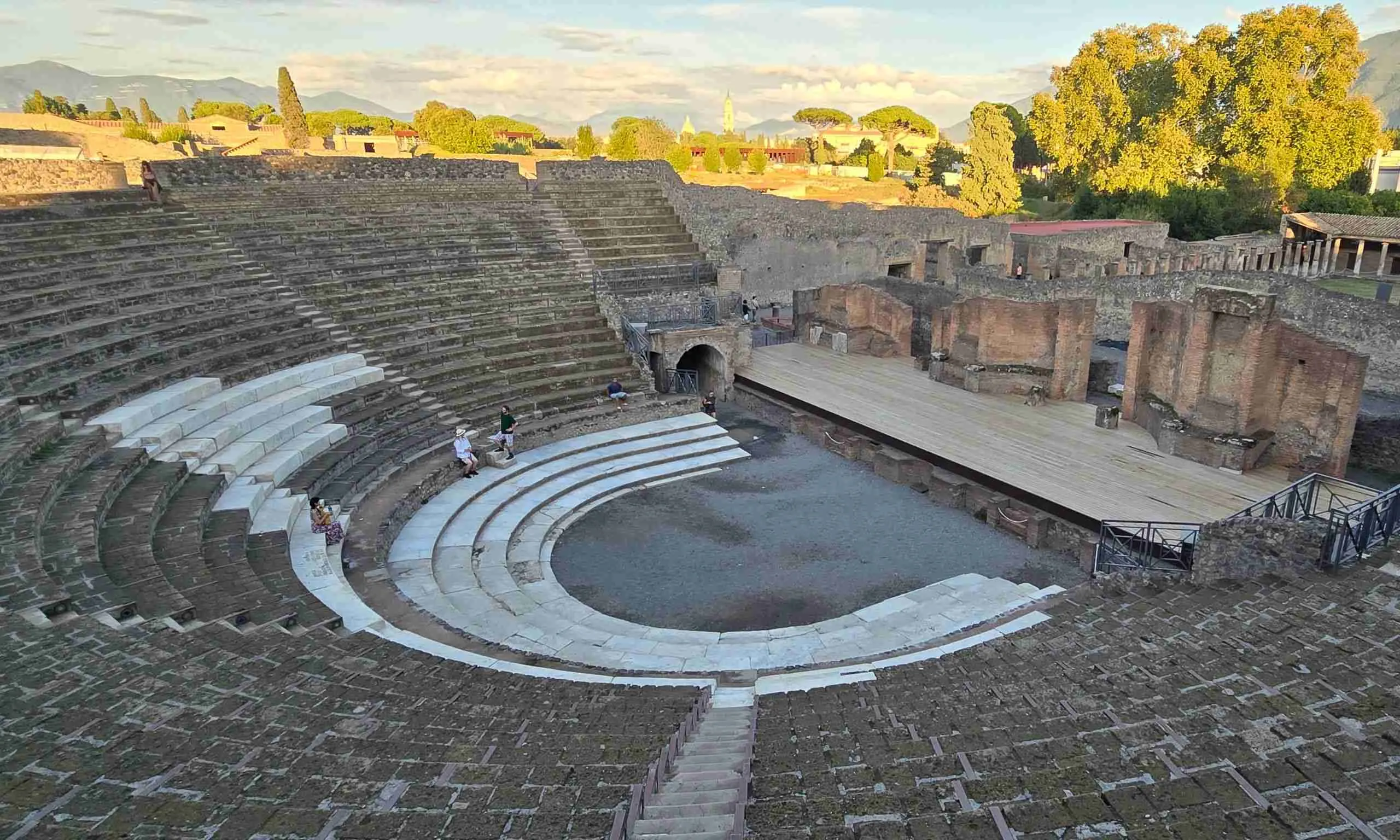
Believed to be the oldest surviving Roman amphitheater, built around 70 BCE and capable of seating an estimated 20,000 spectators. It predates Rome's Colosseum by more than a century.
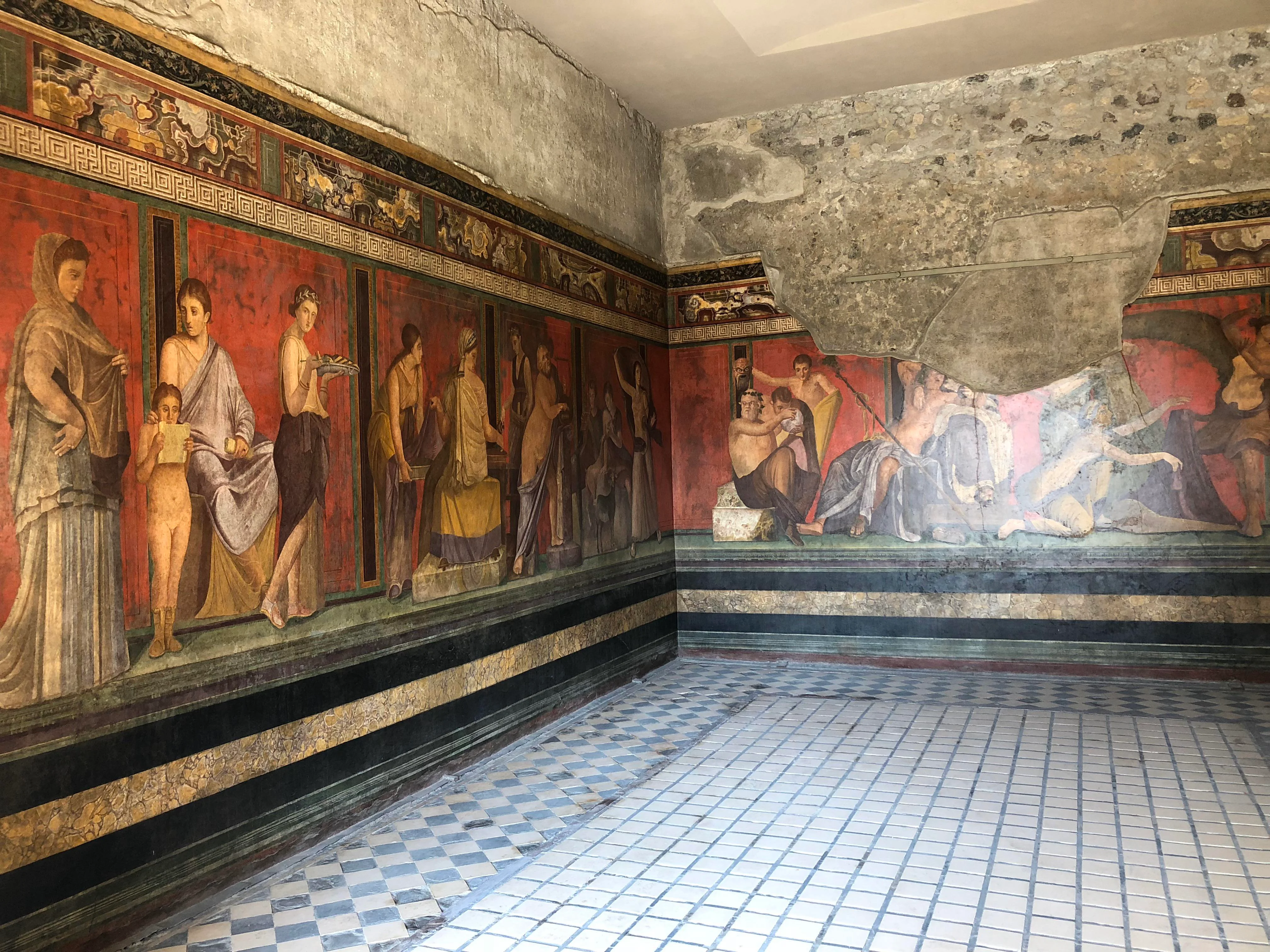
A suburban villa just outside the city walls, renowned for a continuous fresco frieze thought to depict rites tied to the cult of Dionysus. The cycle spans a full dining room and remains one of the best-preserved large-scale paintings from antiquity.
One of the oldest public bathing complexes in the Roman world, featuring separate sections for men and women along with a covered gymnasium. Sections of its vaulted ceilings and stucco decoration remain intact nearly 2,000 years later.
A preservation area displaying plaster casts of victims caught in the final hours of the AD 79 eruption, made using a technique developed in the 1860s to fill voids left by decomposed bodies in the hardened ash. Thirteen casts are arranged here in the positions in which they were found.
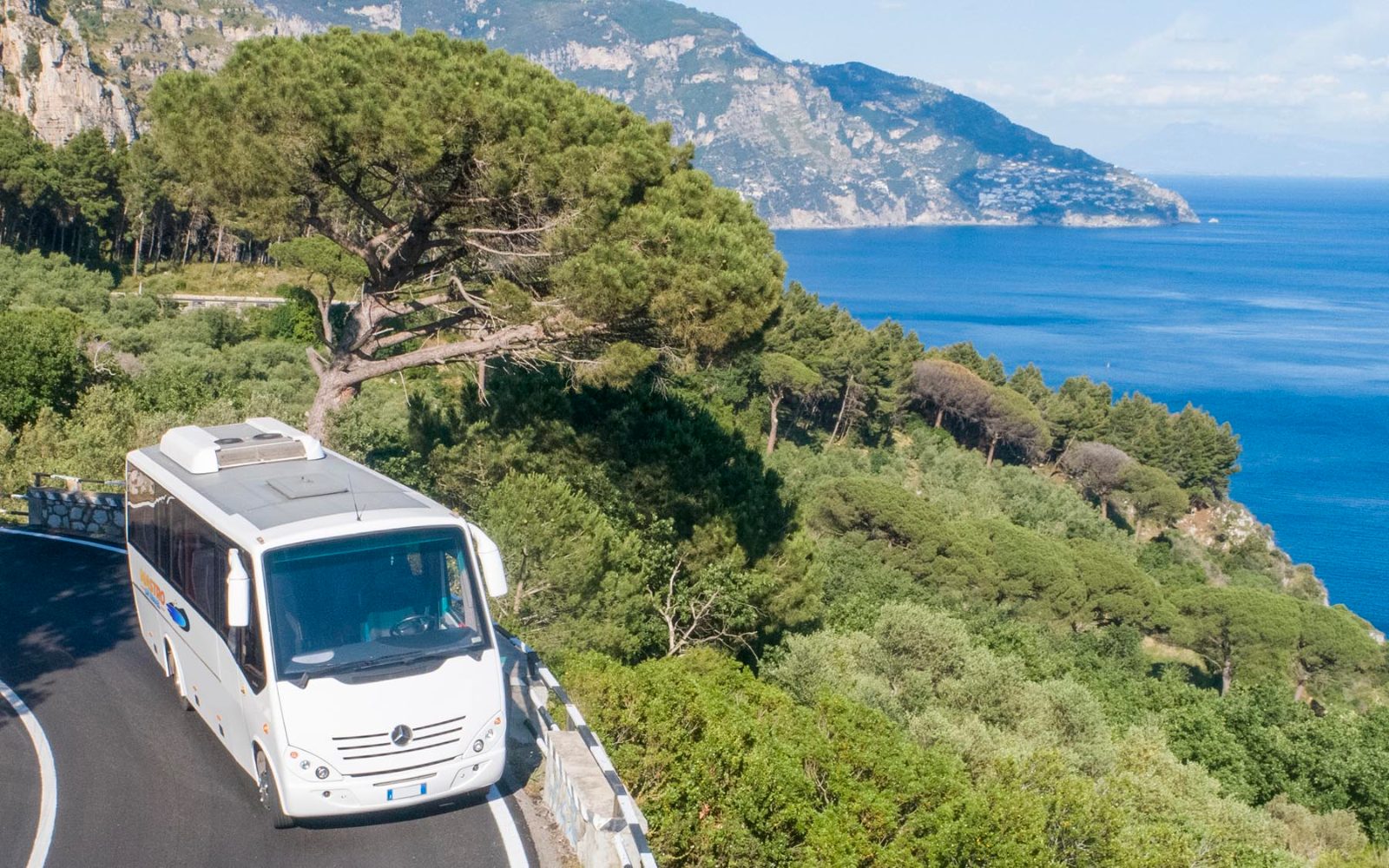
You leave Sorrento in the morning and follow the peninsula road, watching the Bay of Naples open up before the coach turns inland toward the gates at Via Villa dei Misteri. You step through Porta Marina and the modern world drops away; standard adult entry is 20 EUR per person, and the paved incline climbs straight into the forum. You pause where the basilica columns frame Vesuvius, then follow the Via dell'Abbondanza east, boots on the same basalt slabs cut by Roman carts. You duck into the House of the Faun, cross its atrium, and stand over the mosaic threshold. Further on you reach the Lupanar, the thermopolia counters, the bakery with its millstones still in place. A good pompeii tours from sorrento itinerary times your arrival for 09:00 to 10:30, before the heat settles over the open streets and the crowds thicken. You carry water, keep to the shaded colonnades, and let the guide read the painted graffiti aloud. Near the end you reach the plaster casts, and the site stops feeling like archaeology. You walk back out through the same gate by early afternoon, the ruins behind you and Vesuvius still holding the horizon, and the coach returns you to the Sorrento coast.
All the details about your upcoming adventure in one place
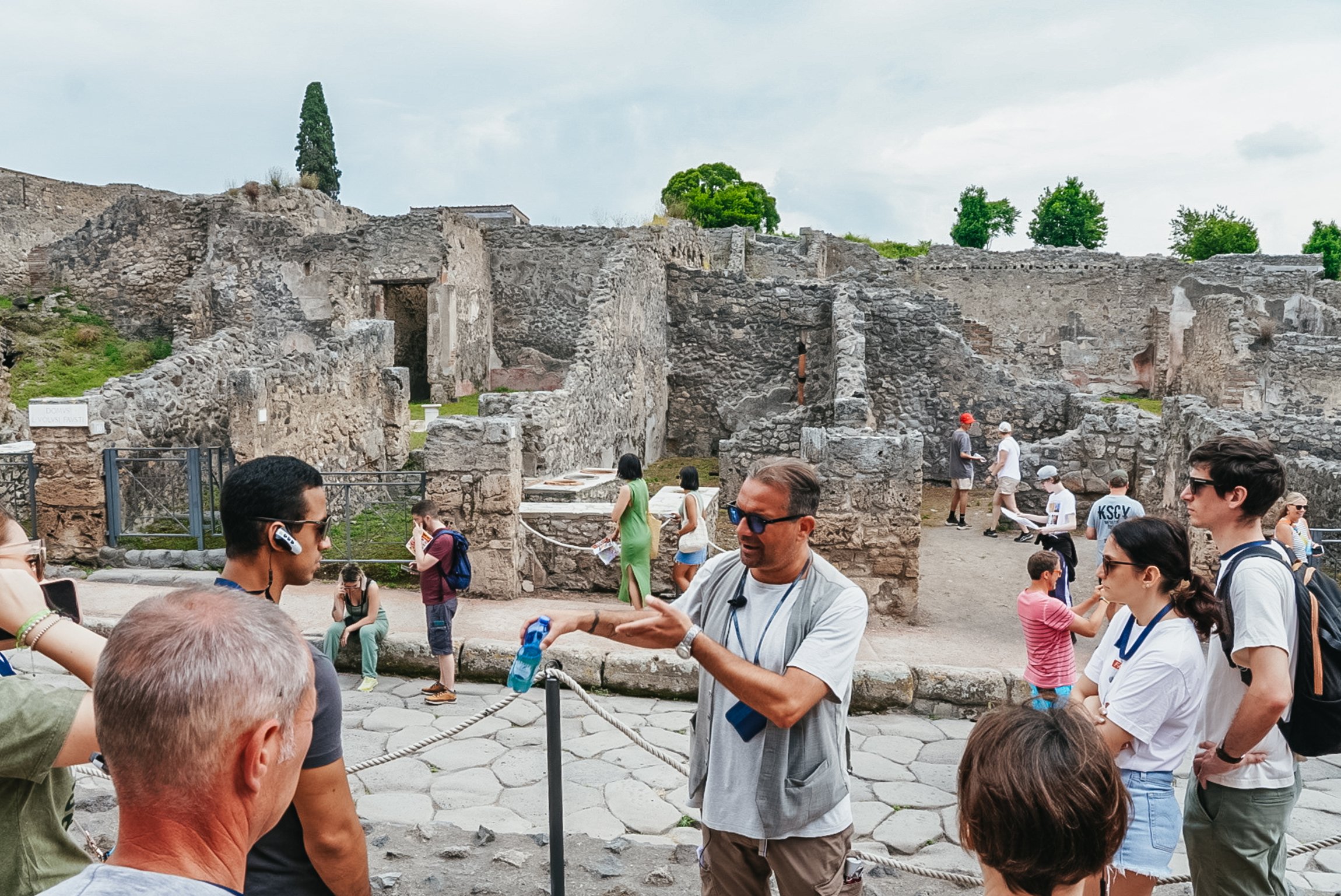
Pompeii tours from Sorrento carry you along the Bay of Naples to the excavated Roman city buried by Vesuvius, where forum ruins, frescoed villas, and stone-paved streets sit under the open sky. A guided archaeological visit pairs an expert who reads the site's plaster casts, amphitheatre, and thermal baths with easy coach transfers from the Sorrentine coast. Booking pompeii tours from sorrento tickets in advance secures your entry slot and a smoother start to the day.
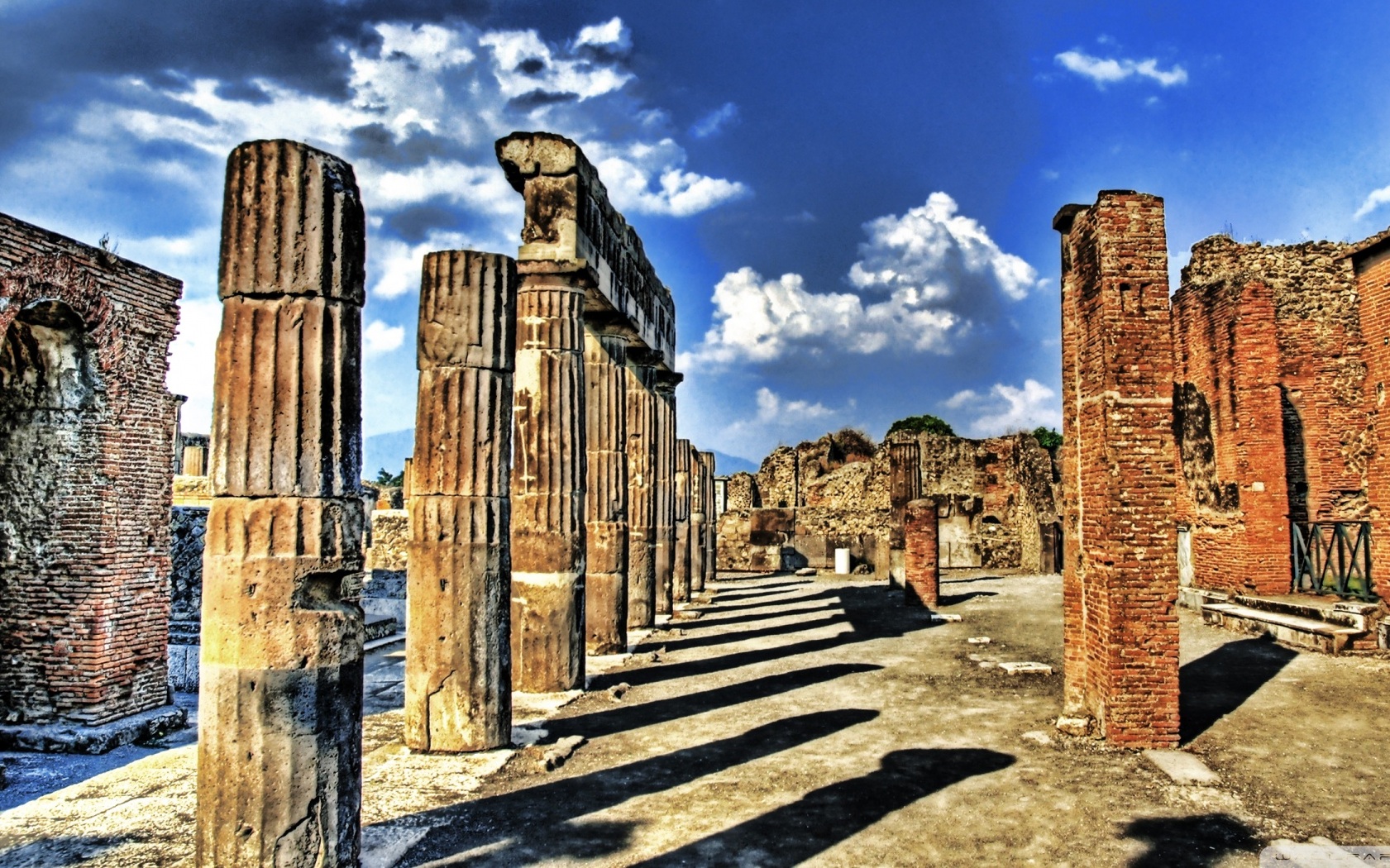
The eruption of Vesuvius in 79 AD buried Pompeii under roughly six metres of pumice and ash within a single day, and that violence became preservation. A city of some 12,000 people vanished, then waited, sealed beneath the volcanic layer until systematic excavation began in 1748 under the Bourbon king Charles III. What emerged was not a ruin in the ordinary sense but a Roman town caught mid-sentence: loaves still in ovens, election notices painted on walls, wheel ruts worn into basalt paving. Pompeii tours from sorrento connect a modern resort coast to that stopped clock, tracing a short overland route around the Sorrentine peninsula to the gates at Via Villa dei Misteri. The site today covers around 44 hectares, of which roughly two-thirds have been uncovered, making it one of the largest continuous archaeological excavations anywhere and a UNESCO World Heritage listing shared with Herculaneum and the Villa Poppaea at Oplontis. The architecture rewards attention. The forum, framed by the surviving columns of the basilica and the Temple of Jupiter, remains the civic heart, with Vesuvius standing behind it as a permanent reminder of the town's fate. The Villa dei Misteri, just outside the ancient walls, holds a fresco cycle in vivid Pompeian red whose Dionysiac initiation scene is among the most complete wall paintings to survive from antiquity. Domestic detail persists everywhere: the House of the Faun with its bronze dancing figure, the Lupanar with its explicit painted signage, the thermopolia counters where hot food was once served to the street. Casts of the victims, made by pouring plaster into the voids left by decomposed bodies, give the excavation its unsettling human register. These are not sculptures but the exact postures of people at the moment the surge cloud reached them. That immediacy is what distinguishes the ruins from grander but emptier classical sites. Skip-the-line pompeii tickets and guided routes exist because the scale is genuinely disorienting; without direction, visitors miss the amphitheatre, the palaestra, and the quieter residential insulae along the Via dell'Abbondanza. Sorrento's proximity makes the excavation an easy fixture of any Bay of Naples itinerary, and a well-organised sorrento to pompeii guided tour turns 44 hectares of stone into a legible narrative of Roman daily life. The gita a pompei da sorrento remains popular precisely because the place resists summary. Pompeii tours from sorrento offer structure to a site that, left to chance, overwhelms as often as it reveals, and repeat visitors still find rooms they had never entered.
A Roman town caught mid-sentence: loaves still in ovens, wheel ruts worn into basalt paving.
There is no formal dress code, but comfortable, closed-toe walking shoes are strongly recommended since the ancient basalt streets of Pompeii are uneven and can be slippery when worn smooth. Many operators offering pompeii tours from sorrento tours advise loose, breathable clothing and a hat, since the ruins offer very little shade across their 22 hectares of excavated area.
Bags are subject to a visual security check at both the Porta Marina and Piazza Anfiteatro entrances, and large backpacks or suitcases larger than standard carry-on dimensions must be left at the free cloakroom near the main entrance. Staff on pompeii tours from Sorrento typically advise carrying only a small daypack with water and sun protection to move quickly through the checkpoint.
Personal photography and video for private use are permitted throughout the archaeological park, including inside most of the excavated houses and the amphitheater. Tripods and professional equipment require prior written authorization from the Pompeii Archaeological Park office, and flash photography is discouraged in the fresco-decorated interiors to protect the pigments.
Children under 18 from EU countries enter free with valid ID, and three baby-changing facilities are located inside the archaeological area. Strollers are workable on the main accessible route but difficult on the narrower side streets with original Roman paving.
The official "Pompeii for All" route runs about 3.5 km from the Piazza Anfiteatro entrance toward the Forum and Sanctuary of Venus, using ramps and fiberglass surfaces over the ancient stonework, though some grades exceed 8% and small level changes remain. Free foldable wheelchairs can be reserved in advance by phone at +39 081 857 5347, and four accessible restrooms are located along the route.
Outside food and sealed drinks may be brought inside the park and consumed at designated rest areas, but eating is not allowed inside the roped-off houses, temples, or fresco rooms. Water fountains with potable water are located near the Forum and main entrances, and a self-service cafeteria operates inside the site during opening hours.
Quiet compared with weekend crowds
Busier ahead of the weekend
Heaviest foot traffic of the week
Hours
Open daily 09:00–19:00, arrive by 10:30 to beat the coach groups
Public transport · About 25–30 minutes · Around 3.30 EUR one-way
Take the Circumvesuviana train (EAV) from Sorrento station toward Naples and get off at Pompei Scavi–Villa dei Misteri, the stop directly opposite the Porta Marina entrance. Trains run roughly every 30 minutes.
Car · About 30–40 minutes depending on traffic · Parking typically 3–5 EUR per hour
Drive the SS145 or A3 motorway from Sorrento toward Pompei; paid parking lots are available near both the Porta Marina and Piazza Anfiteatro entrances.
Taxi · About 30–35 minutes · Roughly 60–85 EUR one-way
Private taxis run directly from Sorrento to the Porta Marina or Piazza Anfiteatro entrance without transfers.
Campania Express · About 25 minutes · Around 4 EUR one-way
A tourist-oriented train with guaranteed seating and air conditioning runs the same Circumvesuviana route between Sorrento and Pompei, stopping at fewer stations.
Most operators running pompeii tours from Sorrento allow free cancellation up to 24 hours before the scheduled departure, with a full refund issued to the original payment method. Standard entrance to the site itself costs 20 EUR per adult, and this admission fee is generally non-refundable once a timed slot has been used.
Recommended time
3-4 hours
Three to four hours covers the Forum, House of the Faun, House of the Vettii, and the amphitheatre without rushing, which is the pace most pompeii tours from sorrento are built around. Trim to 2 hours if you only want the Forum, Lupanar, and a quick look at the Villa of the Mysteries, or extend past 5 hours if you want the suburban villas and quieter side streets too. Queues at the entrance gates build fast after mid-morning, so an early start keeps both the ticket line and the ruins themselves easier to move through. Add extra time on hot afternoons, since the site has almost no shade and pace naturally slows once the sun is high.
Crowd levels through the day
Weather · crowds · average price — dots go green to amber to red as each metric rises.
Mild temperatures around 15–22°C and thinner crowds than summer make March through May comfortable for walking the exposed ruins. Wildflowers bloom along the ancient streets, and rain showers are occasional rather than frequent.
Daytime temperatures regularly reach 30–35°C with almost no shade across the site, and July and August bring the heaviest tourist volume of the year. Arriving close to opening or visiting on a weekday helps offset both the heat and the queues.
September and early October retain warm, dry weather in the low-to-mid 20s°C while crowds thin noticeably after the summer peak. By November, cooler and wetter conditions set in, closer to winter patterns.
December through February is the quietest season, with daytime temperatures around 8–13°C and occasional rain. Shorter daylight hours mean less time to explore before the site closes.
During summer, tickets for the busiest morning slots can sell out days in advance, so reserving online before traveling from Sorrento avoids being turned away.
Circumvesuviana riders should get off at Pompei Scavi–Villa dei Misteri, not Pompei Santuario on the separate Trenitalia line, since the two are easily confused on route planners.
Bag storage near the entrances sometimes requires coins, so keeping a few euros in change avoids delays at the checkpoint.
Mobile signal is inconsistent across the 22-hectare site, so saving a map of the ruins beforehand helps with navigation between the Forum and outer villas.
The original Roman paving stones are uneven and can twist an ankle in new or thin-soled shoes.
The smaller, better-preserved site is a short ride further up the same Circumvesuviana line, making it feasible to see both in one long day.
Only a limited number of foldable wheelchairs are available at the entrances, so those needing one should call ahead rather than arrive expecting availability.
Via Villa dei Misteri 2, 80045 Pompei NA, Italy
Main entrance nearest Pompei Scavi train station
Get directionsVia Plinio, 80045 Pompei NA, Italy
Accessible entrance point for the "Pompeii for All" route
Get directionsVia Nolana, 80045 Pompei NA, Italy
Secondary entrance and elevator exit point
Get directionsPompeii began as a settlement of the Oscan people in the sixth century BC. The town sat near the mouth of the Sarno River, a position that made it a busy trading centre. Greeks and Etruscans passed through in turn. By 80 BC the Roman general Sulla had turned Pompeii into a Roman colony named Colonia Cornelia Veneria Pompeianorum. Under Rome the town flourished, with a forum, an amphitheatre built around 70 BC, and grand houses lining paved streets. Many visitors who book pompeii tours from sorrento arrive expecting ruins alone; they find instead the frozen texture of a working Roman city. In AD 62 a severe earthquake shook the region and damaged much of the town. Repairs were still underway when the greater catastrophe came. On 24 August AD 79, by the traditional dating, Vesuvius erupted. Pliny the Younger, writing later to the historian Tacitus, described the column of ash and the death of his uncle Pliny the Elder. Falling pumice and successive pyroclastic surges buried Pompeii over roughly twelve hours. The city vanished under several metres of volcanic debris and stayed hidden for over sixteen centuries. Rediscovery came in 1748, when engineer Roque Joaquín de Alcubierre began digging under the Bourbon king Charles III. Systematic excavation followed. In the nineteenth century Giuseppe Fiorelli devised the plaster-cast method that captured the voids left by the dead, giving the site its haunting figures. Excavation continues today, and the archaeological park at Via Villa dei Misteri 2 still reveals new frescoes and rooms. A Pompeii archaeological site tour walks streets where cart ruts, bakeries, and graffiti survive. The choice of pompeii tours from sorrento tours reflects the town's easy rail link along the Bay of Naples, and travellers weighing pompeii tours from sorrento tickets are buying entry to one of the ancient world's most complete Roman landmarks. A guided pompeii tours from sorrento tour turns UNESCO heritage stone back into lived history.
Oscan settlers founded Pompeii near the Sarno River as a trading town.
Sulla established Pompeii as the Roman colony Colonia Cornelia Veneria Pompeianorum.
A severe earthquake damaged much of Pompeii, and repairs were still ongoing years later.
Vesuvius erupted on 24 August, burying Pompeii under volcanic debris within about twelve hours.
Roque Joaquín de Alcubierre began systematic excavation under King Charles III of Bourbon.
Giuseppe Fiorelli introduced the plaster-cast technique to record the voids left by victims.
Excavation continues at the archaeological park, still uncovering new frescoes and rooms.
Stand at the lower east side of the Forum facing north and Mount Vesuvius lines up directly behind the Temple of Jupiter's columns, the classic frame chosen by many pompeii tours from sorrento. The open square gives room to include the Arch of Augustus at the edge for scale.
A quiet vineyard courtyard near the Nocera Gate where plaster casts of victims lie behind glass cases; shoot from just outside the barrier for a straight-on view of the casts among the vine rows. Some visitors choose not to photograph this area out of respect.
Climb the external staircase to the top rows of Pompeii's amphitheatre for a wide shot down into the oval arena, with the surrounding countryside and hills visible beyond the rim. The symmetry of the tiered seating reads best from dead center at the top.
Inside the dining room of this suburban villa, the continuous red-ground frieze wraps three walls; position yourself in the center of the room to fit the full sequence of figures in one frame. Entry requires the Pompeii Plus ticket, separate from standard admission.
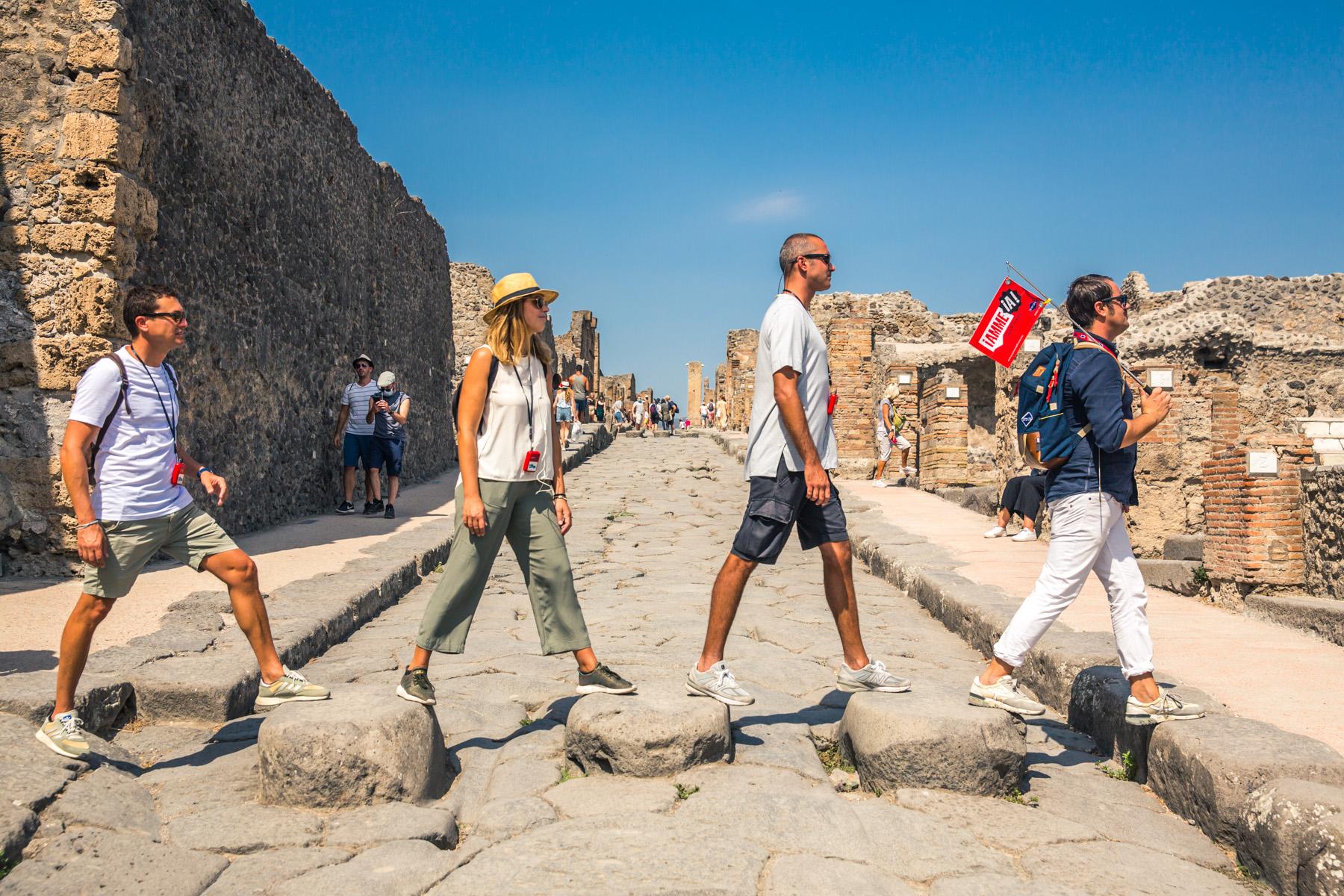
This main thoroughfare offers a long straight corridor of shopfronts, stepping stones, and cart-wheel ruts leading the eye toward distant hills, a favorite angle for anyone comparing sorrento pompeii tour options before booking. Stand at either end for maximum depth.
Pompeii tours from Sorrento work well for families who plan around the site's uneven ground and summer heat rather than fighting it. With good pacing, kids often find the ruins more gripping than a museum, especially once the story of Vesuvius clicks for them.
Cobbles, steps, and slopes make standard pushchairs hard going across most of the site. A baby carrier is more practical, though the 3.5 km Piazza Anfiteatro accessible route works for lightweight strollers on a shorter Pompeii archaeological park tour.
Kids around 7 and up tend to engage with the eruption story and get the most from a highlights route; toddlers manage best in a carrier with short stops rather than long walking stretches.
Three baby-changing points sit along Via dell'Abbondanza, Via di Nola, and the Via Stabiana corner, with toilets near Piazza Anfiteatro, Porta Marina, and the Antiquarium.
Build in shade breaks every 45–60 minutes, since much of the site is open with little natural cover, and carry water for every family member given the exposed, uneven terrain.
Covered spots are limited, so pack ponchos and prioritize roofed structures like the Forum's colonnades or the Antiquarium if showers hit mid-visit.
The archaeological park has two on-site dining options at Casina dell'Aquila, plus a handful of restaurants just outside the Villa dei Misteri gate, so most people planning pompeii tours from sorrento can eat without ever leaving the immediate area.
Table-service dining at Casina dell'Aquila with views over the Forum toward Vesuvius. Neapolitan-leaning dishes and pizza; reservations help since it fills fast around midday. Best suited to a longer, planned break rather than a quick stop, and a good pick when researching a Pompei tour or skip-the-line pompei tickets that include a lunch window.
Run by the same operator inside Casina dell'Aquila, this is the faster on-site choice — trays of pasta, pizza slices and cold dishes at counter prices. Busiest between noon and 2pm; go earlier or later for shorter lines.
Sandwiches, focaccia, coffee and pastries near the food court area, good for a fast refresh mid-visit rather than a full meal. Note the Vicolo del Foro branch is closed for renovation, so confirm which counter is open on arrival.
Standard motorway-style café fare — coffee, bottled drinks, packaged snacks — useful before entry or right after exiting rather than for lunch quality.
A short walk down Via Villa dei Misteri, staff dress in Roman costume and the menu leans into ancient Pompeian recipes alongside modern Italian plates. Good for a memorable sit-down after the ruins, though it can feel touristy and is easy to miss down its side lane.
An outdoor garden setting near Piazza Esedra serving classic Italian and Campanian dishes, a relaxed option for groups wanting shade and table service after a hot morning in the site.
Real experiences from real travelers
Booking one of the pompeii tours from sorrento meant we skipped the ticket queue entirely and were among the ancient streets before the July heat became brutal. Our guide brought the Via dell'Abbondanza to life, pointing out the ruts worn by cart wheels and the faded election slogans on the plaster. Bring a hat and water, there is almost no shade near the Forum.
The drive along the coast from Sorrento was half the pleasure, lemon groves and sea views the whole way. Standing in the Forum with Mount Vesuvius looming behind the columns gives you a chill once you understand what happened here. The guided ruins tour kept our group small so we could actually hear everything.
We did the Sorrento to Pompeii day trip in midsummer and the midday sun on the exposed stone was intense. The plaster casts and the frescoes in the House of the Vettii stuck with me most. Only reason for four stars is the return traffic on the way back was long.
The skip-the-line Pompeii access was the difference between a good day and a wasted one, the standard queue stretched down the block when we arrived. Our archaeologist guide explained the bath houses and the bakery with its stone mills clearly. Comfortable minibus and a small, friendly group.
Walking cobbled Roman streets while a guide decoded the shop fronts and courtyard gardens made the scale sink in. The pompeii tours from sorrento tickets we chose included headsets, which helped near the busier houses. Wear proper shoes, the paving is uneven everywhere.
I had not expected the colours in the preserved wall paintings to survive so vividly after two thousand years. Among the several Sorrento Pompeii tour options we picked the half-day one and it felt like the right amount before the heat set in. The transfer driver was punctual and calm on the winding coastal road.
Late morning in November meant soft light across the amphitheatre and hardly any crowds in the residential quarter. The pompeii tours from sorrento tour we joined ran on time and the guide's knowledge of the eruption's timeline was excellent. A genuinely moving few hours among the ruins.
The pompeii tours from sorrento tours are well organised but block out a full day, the site is enormous and you walk a lot. Seeing the granaries with the amphorae and casts was the highlight for my kids. Pack snacks, the on-site options are limited and pricey.
Reaching the Pompeii archaeological park early with a guide meant we had the Garden of the Fugitives almost to ourselves. The pompeii tours from sorrento option with round-trip transfer removed all the stress of trains and connections. Vesuvius on the horizon is something you do not forget.
Our small-group Pompeii day trip from Sorrento kept things intimate and the guide happily answered every question about Roman daily life. The Stabian Baths and the brothel with its frescoes were fascinating in a sobering way. Start early to beat both the crowds and the summer sun.
Everything you need to know for your journey
Pompeii is open daily from 09:00 to 19:00, and most pompeii tours from Sorrento are timed to start soon after opening.
Standard adult entry to Pompeii costs 20 EUR per person, and this applies to independent visitors as well as most guided pompeii tours from sorrento tickets.
Yes, the official "Pompeii for All" route runs about 3.5 km from the Piazza Anfiteatro entrance and uses ramps over much of the ancient paving, though some sections remain uneven.
Large suitcases, tripods without a permit, glass containers, alcohol, and drones are among the items not permitted inside the archaeological park.
Personal photography is allowed throughout most of the site on a Sorrento Pompeii tour, though flash is discouraged near frescoes and tripods need prior authorization.
Arriving between 09:00 and 10:30 is the recommended window for pompeii tours from sorrento since it avoids both peak crowds and the midday heat.
There is no strict dress code, but sturdy, closed-toe shoes are essential given the uneven ancient streets covered on any Sorrento to Pompeii excursion.
Outside food and sealed drinks may be brought in and consumed at rest areas, though not inside the excavated houses themselves.
Most Sorrento Pompeii day trips use the Circumvesuviana train to Pompei Scavi–Villa dei Misteri station, a roughly 25-30 minute ride from Sorrento.
Yes, children under 18 from EU countries receive free entry, making pompeii tours from sorrento tours a common family day-trip choice.
Most operators offering pompeii tours from sorrento tours allow free cancellation up to 24 hours before departure, while the 20 EUR site admission itself is generally non-refundable once used.
Herculaneum and Mount Vesuvius sit on or near the same Circumvesuviana train line and are commonly combined with Pompeii landmarks in a single day from Sorrento.
A small on-site museum displaying artifacts, frescoes, and several plaster casts of eruption victims. It sits near the Piazza Anfiteatro entrance and requires no extra ticket beyond general admission.
A villa just outside the main city walls famous for a continuous frieze believed to depict initiation rites. It is one of the best-preserved fresco cycles from the ancient world.
A large open training ground once used by young Pompeians for sport, bordered by a swimming pool foundation. Rows of plane trees have been replanted along its perimeter.
A 19th-century basilica in the modern town of Pompei, distinct from the ancient ruins, known for its bell tower and pilgrimage tradition.
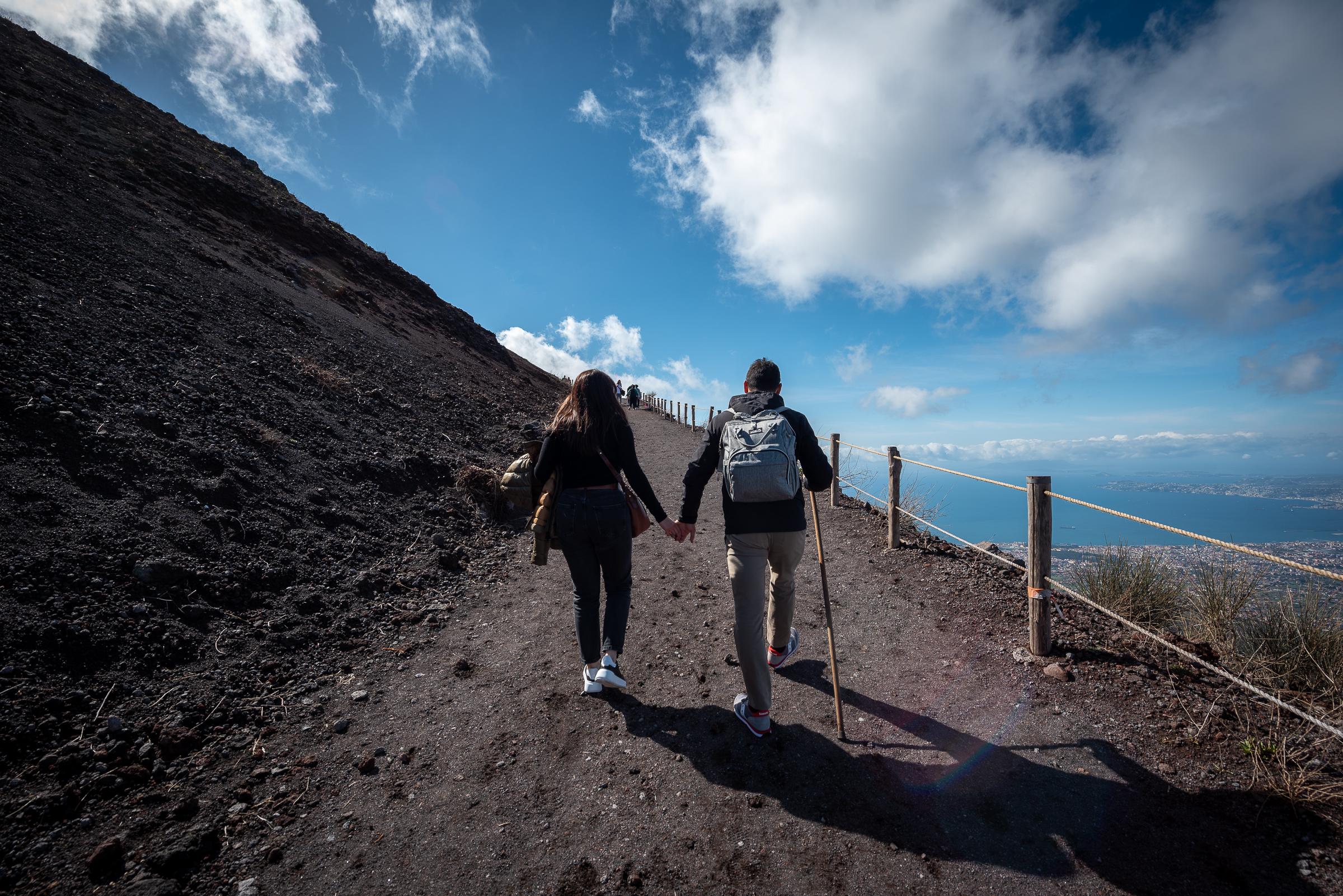
The volcano responsible for the AD 79 eruption is visible from many points inside the excavations and can be visited separately via a marked crater trail.
A cluster of hotels and B&Bs around Piazza Bartolo Longo, convenient for early entry at Porta Marina or Piazza Anfiteatro.
Small hotels near Piazza Tasso offer easy access to the Circumvesuviana line for a same-day round trip to the ruins.
A quieter coastal town on the same train line, often cheaper than Sorrento or Naples for overnight stays.
Join thousands of happy travelers who have discovered this incredible experience
Book Your Experience Now